Wallets
ISPs, ASPs and Harry will not be able to work together without money.
A wallet is service representing a money-holder. Harry's netlets
can carry their own wallets to pay for the services they use. For
Harry's game netlet to pay, say, a database netlet:
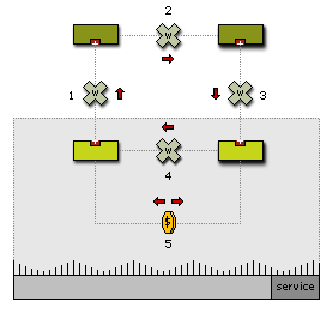
- Harry's game netlet generates a warrant from its wallet. Since it
is its own wallet it is permitted to do this. The warrant is for the
right kind and quantity of payment needed.
- The game netlet passes the wallet warrant to the database netlet.
- The database netlet passes it to its own wallet.
- Recall that a warrant is a pass card to use a service in a particular
way. This warrant is a pass card to extract a certain kind and quantity
of payment. The database's wallet shows the warrant to the game's
wallet, saying ``Look, I have permission to take this much money
from you''.
- The game wallet and database wallet perform the money transfer.
The actual mechanics of the payment (step 5) are left to the wallets,
leaving the applications (the game, and the database) to get on with
their main jobs and, more importantly, wallets only need to trust
each other, not the service they are paying for. All this is illustrated
in Figure ![[*]](crossref.png) .
.
Figure:
Harry's game netlet (top left) needs to buy services from a database
(top right). Each has its own wallet netlet, which is their access
to a banking service. To pay for the database Harry's game netlet
takes a warrant from its wallet which allows access to an agreed sum.
This is eventually passed back to the same wallet which then realises
the payment can be settled with whatever presented it--in this case
the database's wallet. Each step in the warrant's journey represents
a trust relationship, which is why the wallets cannot talk directly
at once. In this example the two wallets are part of the same service
from the same bank, so the transaction is a simple money transfer
from one account to another. However, in practice the mechanism used
is entirely up to the wallet creators.
|
|
In reality a wallet would be implemented by a bank, while being carried
by a netlet. This means:
- If Harry and the database service both use a wallet from First Fictional
Inc, then the transfer of money from one wallet to another is just
a simple account transfer internal to First Fictional.
- Several banks can together arrange their own transfer mechanisms,
operating a procedure like central clearing in the UK.
- The banks can choose to program their wallets exactly as they see
fit. They can choose their own cryptography techniques, communications
mechanisms, and exactly how much goes on on the Internet or behind
their firewalls.
Note also that wallets (and warrants) are not tied to any particular
business models. This is completely at the discretion of the service
providers and consumers.
Nik Silver
2001-10-15


