


Next: Basic discovery services Up: Node features Previous: Warrants and security Contents
Because a node may be more than one machine, the ISP, or whoever owns the node, can offer a much more reliable service. The same goes for ASPs: it helps their service become more widely available.
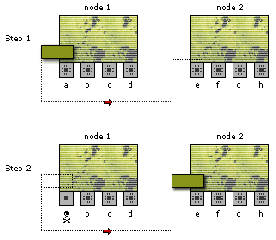
If a machine within a node needs to shut down it can tell the netlets
so they can close themselves down gracefully, perhaps moving to another
location, perhaps on the same node. Meanwhile new netlets can still
move onto the node without worry, because the node itself is still
available. This is shown in Figure ![[*]](crossref.png) .
.
|
Also, with several servers in the same node there are greater trust advantages for netlets which happen to be running on different servers of the same node. Suppose Harry has two netlets running on the same node. If one requests the ZFData service then the node can download it, and bind it to the netlet. If the second netlet then asks for the same service the node does not have to download it and perform the security checks again--because all that has already been done.
Nik Silver 2001-10-15